01Properties
Measured on the printed part
Values according to the technical data sheet, measured on printed test specimens, just as you will use the material. “–” means: not stated in the data sheet.
| Property | Test direction | Unit | Value |
|---|---|---|---|
| MECHANICAL | |||
| Density | – | g/cm³ | 1.09 |
| Tensile modulus | x-y 0° | MPa | 2,442 |
| Tensile modulus | x-y 90° | MPa | 454 |
| Tensile strength | x-y 0° | MPa | 25 |
| Tensile strength | x-y ±45° | MPa | 16 |
| Tensile strength | x-y 90° | MPa | 6 |
| Stress at break | x-y 0° | MPa | 24 |
| Elongation at break | x-y 0° | % | 4 |
| Impact strength (179eU) | – | kJ/m² | 13 |
| THERMAL | |||
| Glass transition temperature | – | °C | – |
| Heat deflection temperature (HDT A, 1.8 MPa) | – | °C | – |
| ELECTRICAL & OTHER | |||
| Water absorption (24 h) | – | % | 0 |
| Volume resistivity | – | Ω·m | > 10¹² |
02Material & processing
Acid-resistant, waterproof, elastic
Material properties
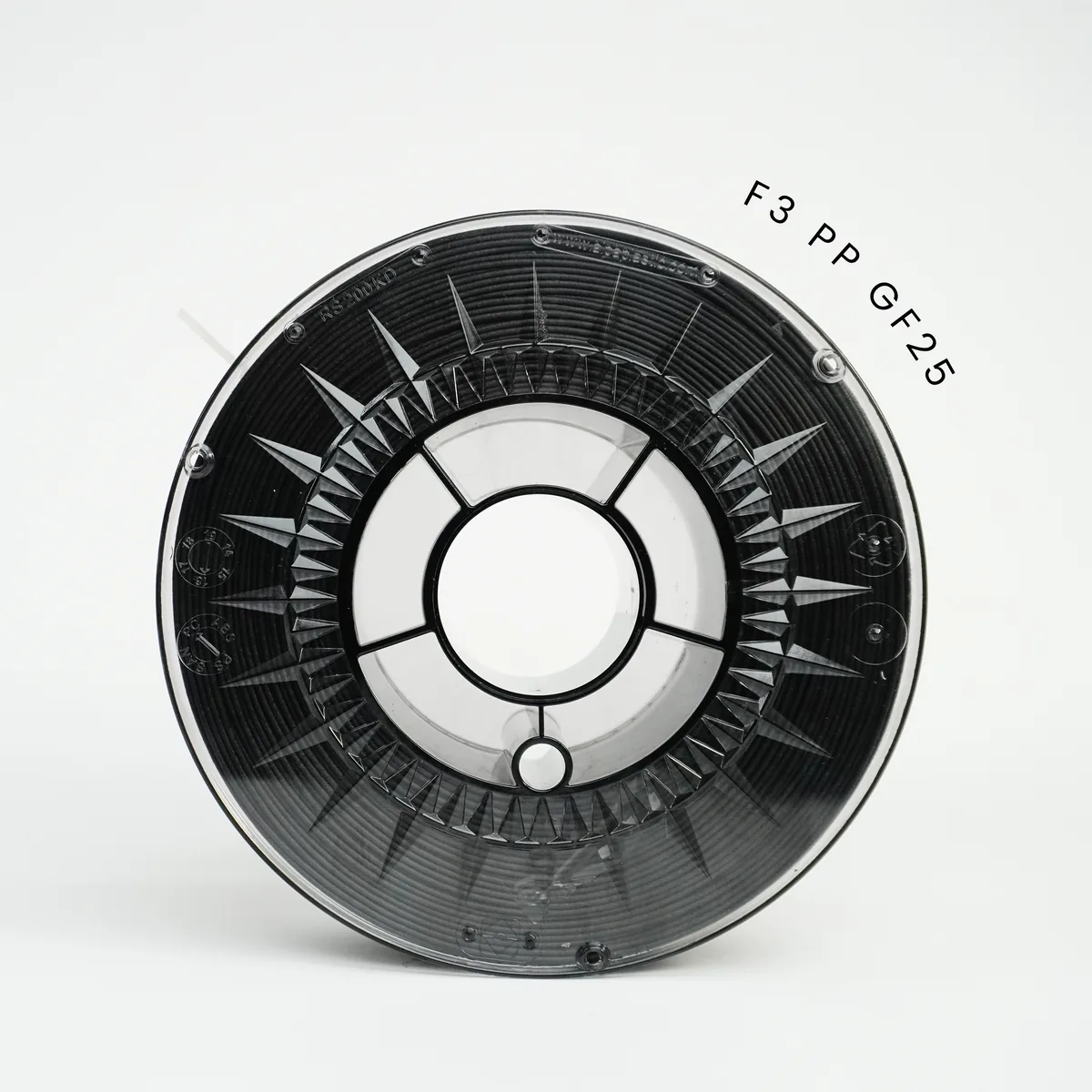
Technical polypropylene filament for 3D printing. The material is modified for use in 3D printers and, thanks to the added fibres, shows the lowest tendency to warp during printing.
Its acid resistance and residual elasticity make it suitable for applications where flexibility in operation and contact with corrosive media matter. Resistant to oil, grease, acids and many chemicals, good weather resistance.
Due to the material, strength is considerably lower than with polyamides. Design critical areas and wall thicknesses with more material.
Processing notes
- 01Nozzle from 0.6 mm, abrasion-resistant. Smaller nozzles can clog because of the fibres.
- 02No drying needed: the spool can be stored open.
- 03Direct drive extruder recommended.
230 °C
80 °C
0.6 mm
50 mm/s
03Printers & downloads
Tested and documented
04Where to buy
Available from
This dealer stocks F3 PP GF25. You will find all dealers and countries on the distributors page.
3DChimeraTo the product in the shop
Similar materials