01Properties
Measured on the printed part
All values measured on printed test specimens, just as you will use the material.
| Property | Test direction | Unit | Value |
|---|---|---|---|
| MECHANICAL | |||
| Density | – | g/cm³ | 1.35 |
| Tensile modulus | x-y 0° | MPa | 8,070 |
| Tensile strength | x-y 0° | MPa | 106 |
| Tensile strength | x-y ±45° | MPa | 51 |
| Tensile strength | x-y 90° | MPa | > 45 |
| Stress at break | x-y 0° | MPa | 106 |
| Elongation at break | x-y 0° | % | 2 |
| THERMAL | |||
| Glass transition temperature | – | °C | 65 |
| Heat deflection temperature (HDT A, 1.8 MPa) | – | °C | 90 |
| Continuous service temperature (IEC 60216) | – | °C | 120 |
| Autoclave cycles | – | °C | up to 180 |
02Material & processing
Stiff, pressure-resistant, non-conductive
Material properties
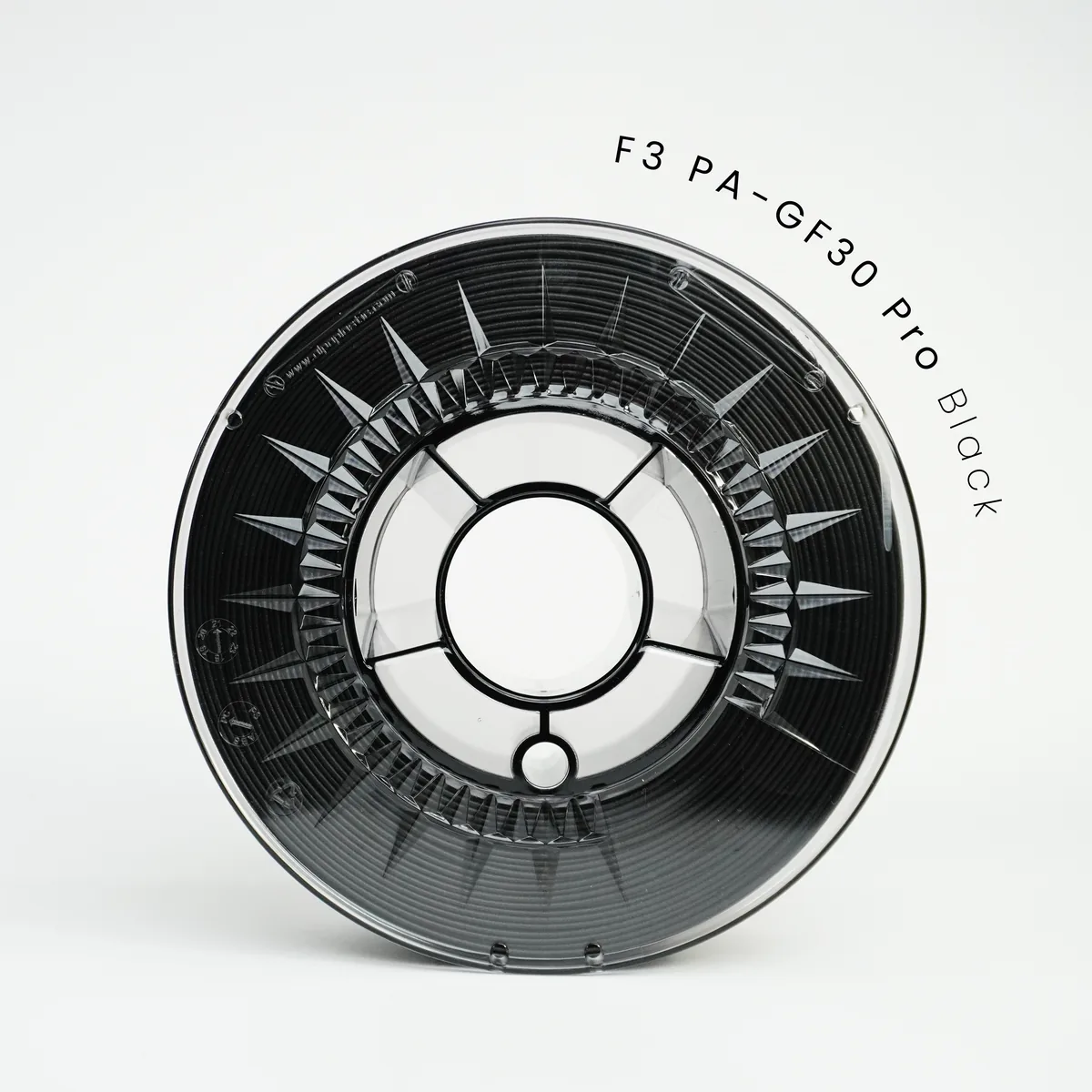
Technical polyamide filament, modified for 3D printing, with an additional glass fibre filler. The glass fibres minimise shrinkage, so warping is largely reduced.
The material offers enormous strength with very low warping and very good layer adhesion. Its good heat and media resistance makes it suitable for high-strength, lightweight parts, including in autoclaves up to 180 °C. Non-conductive. Rough surface with a matt sheen.
Compared with F3 PA-GF Pro: considerably higher stiffness thanks to twice the glass fibre content.
Processing notes
- 01Always use a wear-resistant nozzle.
- 02Store and print the filament dry.
- 03Very stiff filament: it can break at tight bend radii in the feed.
270–285 °C
max. 80 °C
0.4 mm
50 mm/s
03Printers & downloads
Tested and documented
04Where to buy
Available from
These dealers stock F3 PA-GF30 Pro. You will find all dealers and countries on the distributors page.
Prusa ResearchTo the product in the shop
3DChimeraTo the product in the shop
3DGBIRETo the product in the shop
Similar materials