01Properties
Measured on the printed part
Values according to the technical data sheet, measured on printed test specimens, just as you will use the material. “–” means: not stated in the data sheet.
| Property | Test direction | Unit | Value |
|---|---|---|---|
| MECHANICAL | |||
| Density | – | g/cm³ | 1.20 |
| Tensile modulus | x-y 0° | MPa | 3,400 |
| Tensile strength | x-y 0° | MPa | 80 |
| Tensile strength | x-y ±45° | MPa | 80 |
| Tensile strength | x-y 90° | MPa | 35 |
| Stress at break | x-y 0° | MPa | 77.31 |
| Elongation at break | x-y 0° | % | 3.56 |
| Flexural modulus | x-y ±45° | GPa | 2.37 |
| Notched impact strength (179eB) | – | kJ/m² | 2.26 |
| THERMAL | |||
| Glass transition temperature | – | °C | 72 |
| Heat deflection temperature (HDT A, 1.8 MPa) | – | °C | 90 |
| Continuous service temperature (IEC 60216) | – | °C | 120 |
| ELECTRICAL & OTHER | |||
| Water absorption (24 h) | – | % | > 0.3 |
| Volume resistivity | – | Ω·m | > 10¹² |
02Material & processing
Unfilled, smooth, strong
Material properties
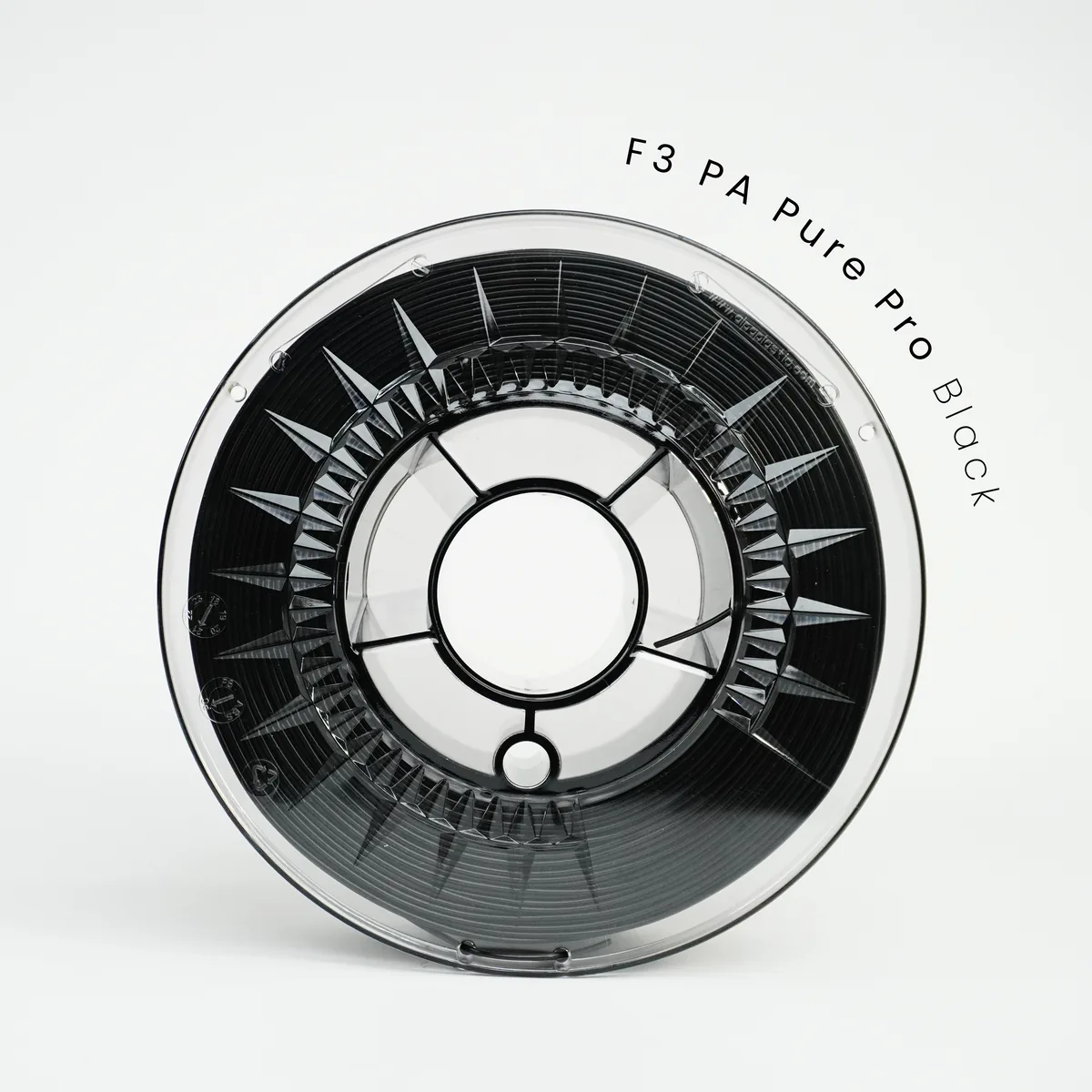
Technical polyamide filament, modified for 3D printing. When printed, the material shows similar strength to injection moulding, with low tendency to warp and very good layer adhesion. Thanks to its good heat and media resistance, it is suitable for high-strength parts.
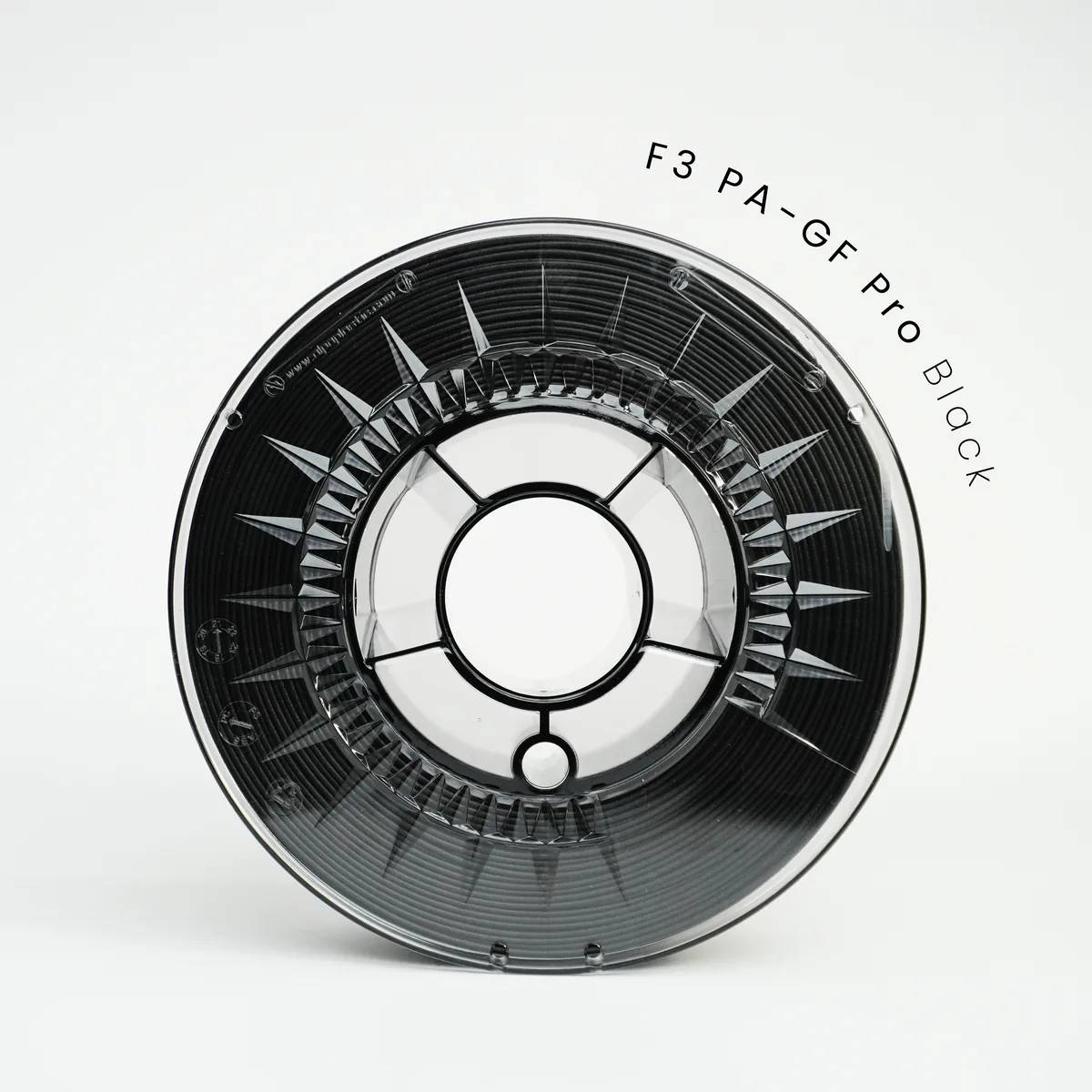
It differs from F3 PA-CF Pro in having no fibres. This makes it suitable as a reference material for the influence of fibres, for multi-material parts and as an alternative when a smooth surface is required or fibres get in the way.
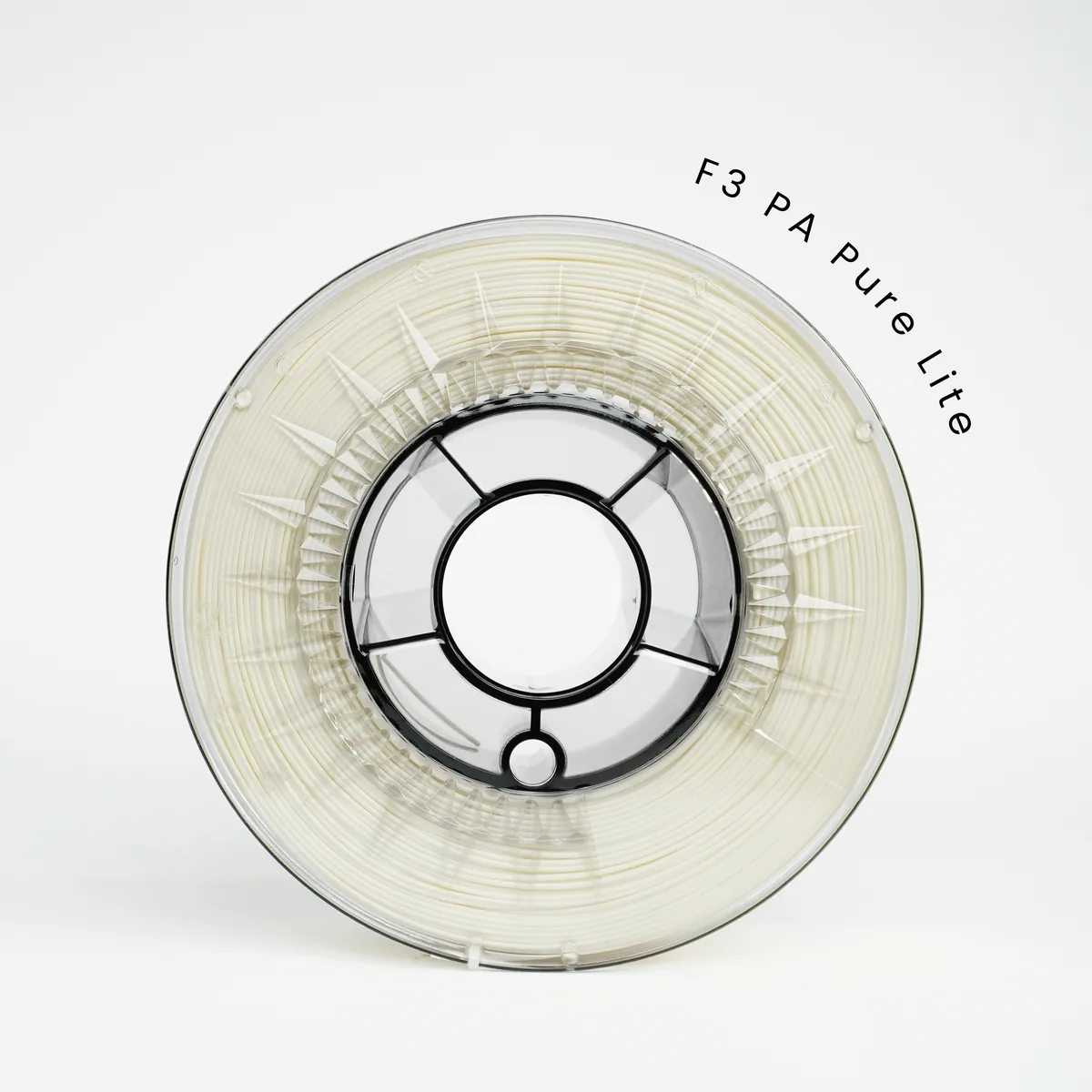
Compared with F3 PA Pure Lite: considerably less heat input when printing and higher strength, but slightly more sensitive to moisture during printing.
Processing notes
- 01Store and print the filament dry.
- 02Part cooling fan at most 30 %.
- 03Printable with any nozzle. No abrasion-resistant nozzle is needed.
270–280 °C
max. 80 °C
0.4 mm
50 mm/s
03Printers & downloads
Tested and documented
Tested on
- 01Prusa MK3S+ (test specimens according to data sheet)
- 02Prusa MK3S+ / MK4S / Core One / Core One L / XL / HT90
- 03Bambu Lab A1 / P1S / X1C / H2D
04Where to buy
Available from
These dealers stock F3 PA Pure Pro. You will find all dealers and countries on the distributors page.
Prusa ResearchTo the product in the shop
3DGBIRETo the product in the shop
Similar materials