01Properties
Measured on the printed part
Values according to the technical data sheet, measured on printed test specimens, just as you will use the material. “–” means: not stated in the data sheet.
| Property | Test direction | Unit | Value |
|---|---|---|---|
| MECHANICAL | |||
| Density | – | g/cm³ | 1.20 |
| Tensile modulus | x-y 0° | MPa | 2,522 |
| Tensile modulus | x-y 90° | MPa | 2,350 |
| Tensile strength | x-y 0° | MPa | 49 |
| Tensile strength | x-y ±45° | MPa | 47 |
| Tensile strength | x-y 90° | MPa | 38 |
| Elongation at break | x-y 0° | % | 2 |
| THERMAL | |||
| Glass transition temperature | – | °C | 72 |
| Heat deflection temperature (HDT A, 1.8 MPa) | – | °C | – |
| ELECTRICAL & OTHER | |||
| Water absorption (24 h) | – | % | > 0.3 |
| Volume resistivity | – | Ω·m | > 10¹² |
02Material & processing
Translucent and dimensionally stable
Material properties
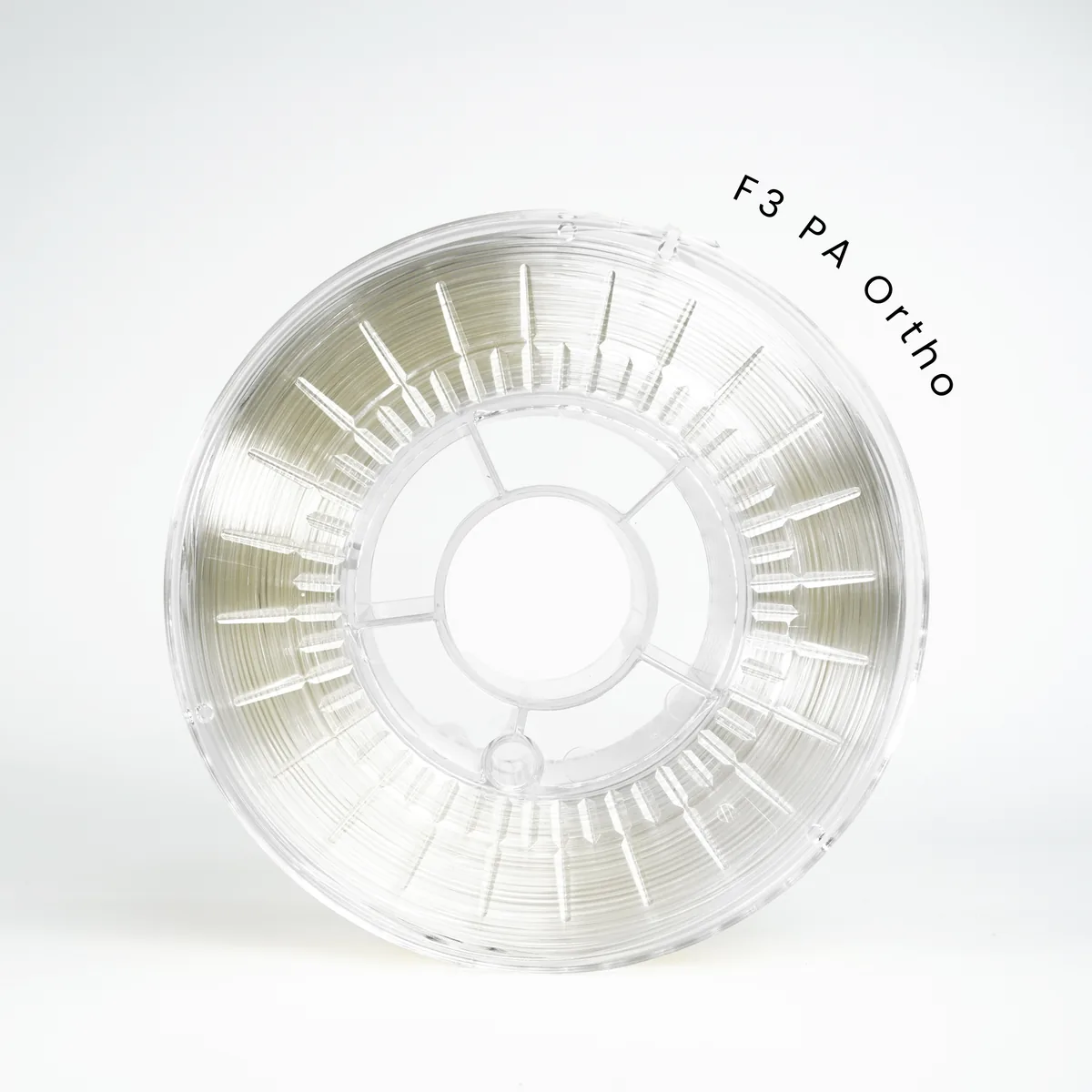
Technical polyamide filament, modified for 3D printing. The material shows good strength with low tendency to warp and very good layer adhesion.
It differs from other polyamides in its high light transmission and good transparency. This makes it suitable for applications that require see-through and lasting strength above 70 °C, such as orthoses, light fittings or displays.
Printed objects become translucent, but not clear due to the printing process. Depending on the light source, the material looks slightly yellowish (artificial light) or slightly bluish (daylight).
Processing notes
- 01Store and print the filament dry.
- 02Part cooling fan at most 30 %.
- 03Printable with any nozzle. No abrasion-resistant nozzle is needed.
250–270 °C
40–80 °C
0.4 mm
50 mm/s
03Printers & downloads
Tested and documented
04More
Similar materials
Further materials from our range that suit similar applications.