01Properties
Measured on the printed part
Values according to the technical data sheet, measured on printed test specimens, just as you will use the material. “–” means: not stated in the data sheet.
| Property | Test direction | Unit | Value |
|---|---|---|---|
| MECHANICAL | |||
| Density | – | g/cm³ | 1.20 |
| Tensile modulus | x-y 0° | MPa | 12,200 |
| Tensile modulus | x-y 90° | MPa | 4,800 |
| Tensile strength | x-y 0° | MPa | 105 |
| Tensile strength | x-y ±45° | MPa | 95 |
| Tensile strength | x-y 90° | MPa | 79 |
| Stress at break | x-y 0° | MPa | 105 |
| Elongation at break | x-y 0° | % | 2.3 |
| THERMAL | |||
| Glass transition temperature | – | °C | 70 |
| Heat deflection temperature (HDT A, 1.8 MPa) | – | °C | 120 |
| ELECTRICAL & OTHER | |||
| Volume resistivity | – | Ω·cm | 10⁵ – 10⁹ |
| Surface resistivity | – | Ω·cm | 10⁵ – 10⁹ |
| Water absorption (24 h) | – | % | > 0.3 |
02Material & processing
Strong and dissipative
Material properties
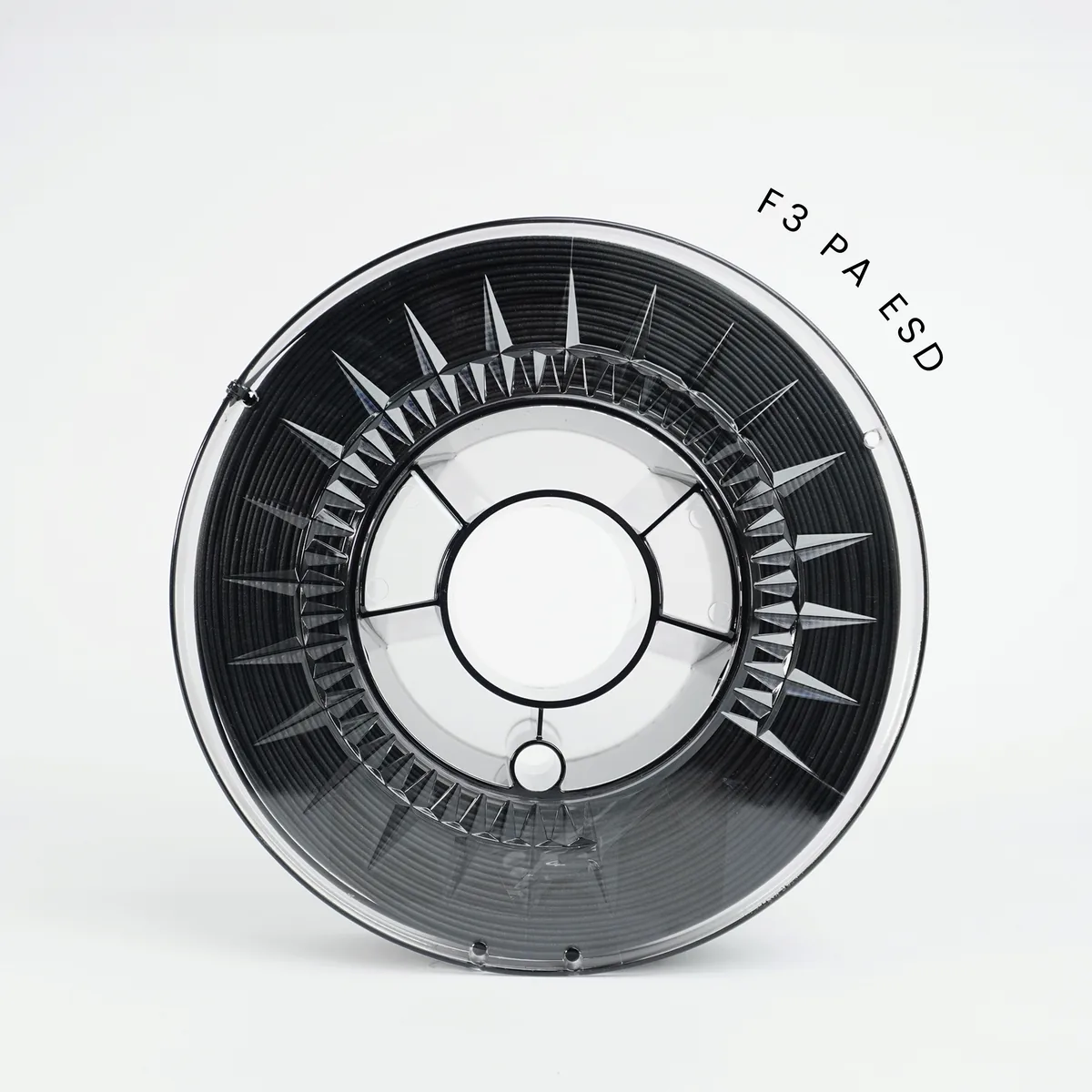
Technical polyamide filament, modified for 3D printing, with an additional filler of carbon fibres and conductive particles. The carbon fibres minimise shrinkage, so warping is reduced.
The material shows enormous strength while retaining impact strength, low tendency to warp and very good layer adhesion. Thanks to its good heat and media resistance, it is suitable for high-strength parts that need to be ESD-dissipative in the printed part. The expected resistance (surface or volume) in the printed part is between 10⁵ and 10⁹ Ωcm. Attractive surface with a matt sheen.
Annealing at 70 °C for several hours can increase crystallinity. This improves strength and resistance in warm, humid conditions.
Processing notes
- 01Always use a wear-resistant nozzle.
- 02Store and print the filament dry.
- 03Build chamber up to 60 °C. We recommend 60 °C for optimum adhesion.
280–310 °C
70–90 °C
0.4 mm
50 mm/s
03Printers & downloads
Tested and documented
04Where to buy
Available from
This dealer stocks F3 PA ESD. You will find all dealers and countries on the distributors page.
3DChimeraTo the product in the shop
Similar materials